Marine Assoumov

painter and collagist
painter and collagist
About the Square
In her advance per series, Marine Assoumov could not avoid dealing with the square. She now pays a tribute, with her means, her manner, her plastic universe and her pleasure of painting, to this worthy icon with a very heavy heredity.
As balanced as it is, the square format, a geometrical figure with an attractive hieratic perfection, defied the painters who often preferred the rectangle and the variations which it authorizes around the divine proportion of the golden section. “One gave me a square, I managed to demolish it”: Bonnard proclaimed after carrying out “the Pastoral”, an ornamental panel intended for the theatre of Chaillot, modifying by the play of the composition this format which he hardly appreciated. Originally, “the Turkish bath” was square, but Ingres transformed the painting into a tondo after the refusal of his client. Finally the precursors, Malevitch and Mondrian, arrived, who took the square as the symbol of their mystical search of the infinite.
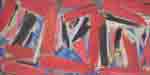
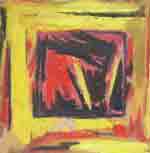
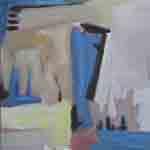
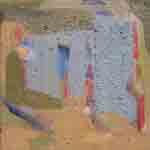
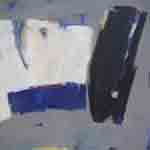
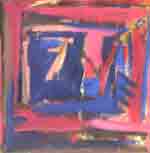
In the series “Around the square”, painted in 2004, Marine Assoumov imposes herself a double constraint, the square as the topic in itself, and the format, also square.
Painter of movement and of elaborate disorder, as we see in the so powerful series “Rugby in body with body” (1997) or “the ruins” (1996), Marine Assoumov puts herself once more in danger in choosing a static form, deprived of any visible direction, fixed in normalized immobility and crystallized materiality in an impassive perfection.
How the painter, bound in this strait-jacket, can offer the spectator the illusion of dynamism, even of a pictorial bursting? How to free oneself from the formal requirement of such a topic when only the dimension of the square authorizes variations, combined with the resources of the composition and coloured rhythms? But the constraint often urged on the creator to carry out mastered works, as the rules of the traditional tragedy prove it or, in a very different register, the entertaining exercises of Oulipo. Marine Assoumov thus exploits here the possibilities of the acrylic whose flexibility, fluidity, ductility and speed of execution manage to destroy the hieratism of the square.
In her series “Studio Fragments” (2001) or “Mental landscapes” (1998), painted with oil, the artist had accustomed us to paintings charged with thick pastes, rich in concretions, aggregates and agglomerates. In this new series, nothing like it, with the choice of acrylic like privileged medium: the scars in the slow viscosity of oil give way to the lightness of transparencies, successive veils and subtle coverings of color. The freedom, even the ardour, with which the brush sweeps the surface of the painting, the illusion of depth caused by the tangles of flat tints make us perceive a new space where the square, traversed with multiple geometries, dissolves in the color, the movement and the light.
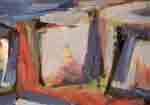
One attends indeed a true collapse of the square. In some paintings, the square, imprisoned inside its frame, seems to lose balance, to waver and finally to dislocate itself while trying to escape from its prison. Sometimes, the square rolls up on itself in a spiral movement, while elsewhere, it is encased in several others squares. Construction is often imposed on geometric standards, improbable remains of squares maybe disappeared (triangles, trapezoids, rhombes, rectangles …), imbricated, superimposed or intertwined, coming to transfigure space, to strangle or widen it ad infinitum, rejoining here, but with a very different manner, the project of Malevitch or Mondrian. Of the square as a theme, simple pretext for the artist, it remains nothing, except for fragments or debris (so beloved by Marine Assoumov)…
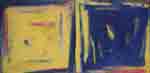
Only some paintings where the square, heavier and more present, is beyond question the main topic, keep a stiffened character: but from their meeting in triptych, the less lively interior rhythm of each painting transforms itself into a dialogue between the three paintings. The erudite distribution of the tone comes to complete the balance of these architectures of forms and to stir up their surface: often subdued colors (gray, blue, carmine, ochre and brown) or vivid ones (bright red or yellow), but always anchored in a register quite far away from the vibrating palette to which the painter had accustomed us in her last series to oil.
By the energy of the line, the force of the language, this series which could have been entitled “the square in all its states” strikes us by the strength and the speed with which Marine Assoumov seems to have brushed it.
But if the gesture is nervous and the immediate draft, contrary to her figurative works whose theme is so strong that it imposes its composition, Marine works over and over again her abstract paintings, month after month, superimposing layers which totally transform the basic painting, testing several choices of composition by a throbbing play of flashbacks. Actually, as testify dozens of paintings being elaborated in the studio, sometimes since more than one year, the painting of Marine Assoumov is the fruit of a slow maturation and a progressive crystallization of the former series.
Thierry Blanchon, 2004