painter and collagist
painter and collagist
Fragments from artist’s studio
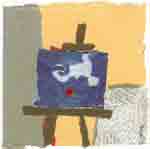
In these fragments of the life of artist, still-lifes and interior sights of studio are combined to show the everydaylife of the artist as a craftsman. It is the traditional topic of the “painter and his model”: here the model is the studio, of course, but appearing in close-up or in remote vision.
The two visions are complementary, the near space with the tools of the painter and the more remote one with his works, completed or in becoming, which strew walls and ground of the studio. Intimacies of studios could one say, because the format of these paintings is modest like their topic. The spectator can contemplate them closely, as the tool is close to the hand… But these reduced dimensions do not prevent us from feeling the impression of space which the sights of studio suggest.
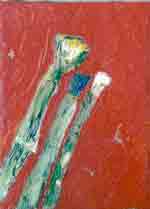
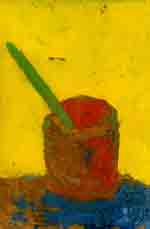
Homage is thus paid to these objects which help the artist to create. Useful objects without ostentation, simple like their materials, wood, glass and metal, which are represented here without setting in scene, in a rather minimalist way.
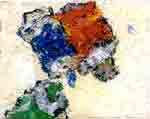
The matter of these small paintings merges with the crusts and agglomerates of painting which cling on the brushes, the boxes and the aluminium of the tubes of colours, when the oil dries with the free air. Pure color of the tubes which spouts out on the canvas (yellow, red, green)… Never the painting was so like the palette, the tube of colour, the knife…
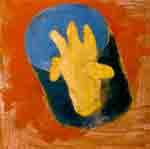
“Fragments of studio” recalls us that painting is this tactile and sensual art even if it is an abstraction… the caress of the brush, the thick and coloured paste these natures alive - and who give life- illustrate the physical relationship of the painter with his materials and his tools …
Marine Assoumov, until now more attracted by the alive one (woman’s scent, rugby) or by space (ruined cities, landscapes,…), finally approaches the world of the things. She painted this series with joy and greediness, finding the pleasure of the re-creation in that of creation.
What seduces Marine Assoumov in painting and led her to become an artist, is the skilled, humble and concrete side of this occupation, so oldfashioned at the time of virtual, the sentimental memory of the green paradise of childish colors…
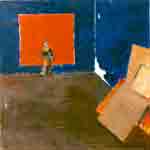
By contrast with natures of studio with subdued tints, the interiors of the artist are simplified. They show us a night studio where the coloured rectangles of piled up paintings burst out… The virgin canvas is not white, the easel dominates the space like a totem and the paintings piled up against the walls seem like many phantom presences or guardian divinities.
The studio is a marvellous play-ground for the painter, who is lucky enough to still experience childish pleasures, with brushes and colors, paper scissors and cuttings. In this intimate and personal space, he organizes his disorder as it pleases himself, piling up papers, frames, rollers of canvases and paintings. This place of creation, work and contemplation, this beloved refuge with accepted disorder, is filled with the phantoms of last and future works. A closed place, withdrawn from the world, where white canvas and coloured matters change ceaselessly, a magic cave which shelters the bulimia of creation, a place of introspection and meditation turned towards the representation of the world.
But the studio is also a territory, a familiar universe, which the painter paces up and down every day. A space for play, and even for fight, as some paintings give evidence. Tubes broken after the battle, paintings in becoming strewing grounds and walls… Space of loneliness full with the presence of the paintings and the absence of the painter, where sometimes a visitor comes wandering …
Only living beings: a face (self-portrait?) and a view of the studio with a small squatted figure, the host who haunts this place, represented here not as a demiurge but as a frail spectator of mysteries never solved. A figure, allusion to the usual representation of the studio, often inhabited, a female face, that of the painter (and not of the model)…
Thierry Blanchon, août 2001